

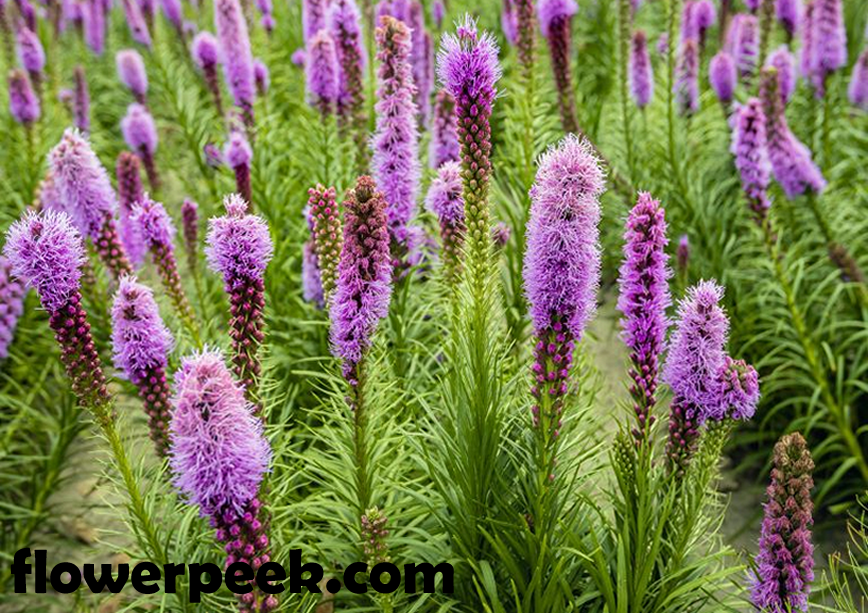
The botanical name of
Liatris is Liatris spicata. The plants belong to the large aster (Asteraceae)
family and they are also known as gayfeather or blazing star. The Liatris plant
is a long-blooming perennial wildflower that is native to eastern North
America. The liatris plants have a highly unusual flower heads that features
tiny star-like blossoms arranged around the long upright bottle-brush spire.
The Liatris plants are usually planted from potted nursery starts or from corms
in the spring after the last frost date. Starting the Liatris plants from seeds
is also possible, although it can take about 2 to 3 years for the Liatris
plants to flower. Below is the basic information about Liatris plants
Liatris Plant Info
The common name: The
common names are dense blazing star, liatris, blazing star, gay feather.
The botanical name: The
botanical name is Liatris spicata.
Family: Liatris is a
member of Asteraceae family.
The plant type: The
plant is herbaceous perennial.
The mature size: The
mature size is about two to four feet tall, nine to eighteen inches wide.
The sun exposure: The
plant prefers full.
The soil type: The plant
does well in medium-moisture, well-drained soil.
The soil pH: Acidic to
neutral (5.5 to 7.5)
The blooming time: The
blooming time is summer to early fall.
The flower color: The
flower colors are white, purple, and reddish-purple.
USDA Hardiness Zones:
The plant is suitable in USDA Hardiness Zones 3 through 9.
The native area: Liatris
is native to Eastern North America.
Liatris Plant Care
Like I said earlier,
Liatris can actually be planted from potted nursery starts, although it is much
more economical to plant the Liatris from bulb-like root structures bought in
bulk.
Light requirement: Make
sure you choose a site with full sun to plant your liatris corms. Actually
these are prairie plants in their native habitat, so the more sun the better
the liatris plant will perform.
Soil requirement: Any
soil with good fertility level can successfully grow Liatris corms, although
quick drainage is important to prevent rot. Very rich soils may require that
you stake the Liatris plants, as the stalks can be a bit floppy. The Liatris
plants prefer a slightly acidic to neutral soil pH. Heavy clay can easily cause
root rot, most especially in winter, if the soil does not drain well.
Water requirement: After
planting you need to water the corms thoroughly. The corms need no additional
irrigation until the stalks sprout. As the Liatris plants begin active growth,
one inch of water a week during the hottest months will prevent stunted flowers
and leaf scorch. Apply water to the base of the Liatris plants, or you can use
drip irrigation in other to avoid spreading fungal diseases.
The Liatris plants need
more water in their first year; afterward, the plants have very good tolerance
to drought and dry soil conditions.
Temperature and humidity
requirement: Hardy in zones three to nine, Liatris plants is quite tolerant of
summer heat and humidity in warm climates, and will nicely survive very cold
winters provided that the soil is not too wet. Wet winter soils can easily
cause the corms to rot.
Fertilizer requirement:
Liatris plants are not a heavy feeder, but if the soil fertility is a little
bit poor you can apply a balanced flower fertilizer each spring as active
growth begins. In most decent soils, however, Liatris plants usually does fine
with no feeding whatsoever.
Pest and disease
control: Liatris plants does not actually suffer from any serious insect problems,
however several fungal diseases can occur, including leaf spot, stem rot, rust,
powdery mildew, and verticillium wilt. One of the best approaches is to prevent
these diseases by giving the Liatris plants good sunlight and air circulation.
Mild fungal diseases, such as powdery mildew and leaf spot are usually not
serious and may not even require treatment. More severe diseases sometimes can
easily be treated with fungicides but may be necessary to remove and destroy
any badly affected plants.
Post a Comment